November 21, 2025 · 7 min read · Content Investment
As the global media landscape transforms into a high-velocity, content-hungry ecosystem, financial accuracy has become as critical as creative excellence. Whether producing a large-format Ramadan drama, investing in a streaming catalog, or developing multi-platform originals, media companies cannot afford ambiguity in their cost structures. Yet one foundational principle remains widely misunderstood or inconsistently applied across the region: the correct allocation of fixed production costs into Cost of Goods Sold before calculating gross margin.
This practice, standard in manufacturing for decades, is increasingly central to modern content finance. In an industry where programs are the inventory, the failure to allocate fixed costs properly can distort margins, misprice content, and conceal operational inefficiencies.
This article explains why proper allocation matters, how it aligns with international reporting frameworks, and shares real-world media cases that demonstrate its impact.
Content Is Inventory: The Core Principle Many Media Organizations Miss
In manufacturing, no one questions that product cost includes not only materials and labor but also factory payroll, depreciation, utilities, equipment amortization, and fixed overheads. These costs are capitalized into inventory and expensed through cost of goods sold upon sale. The same principle applies, almost identically, to media.
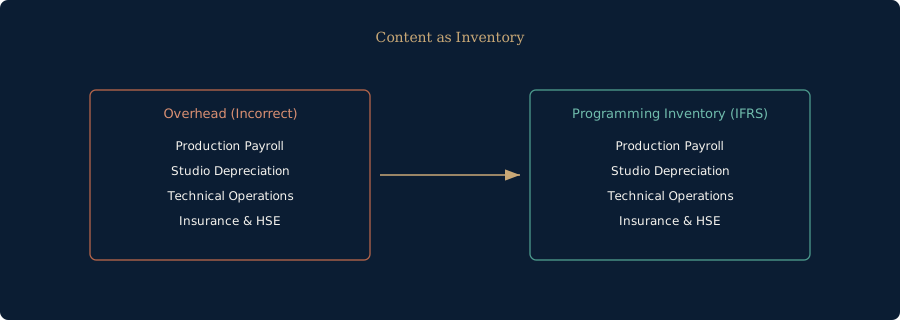
For broadcasters, streamers, and production houses, content is the manufactured product, and the following costs must be capitalized into programming inventory:
- Producer and production manager payroll
- In-house camera crews, editors, coordinators
- Studio rent and stage usage charges
- Depreciation of cameras, lights, editing suites, and storage
- Technical operations supporting production
- Production insurance and health, safety and environment costs
- Directly attributable production-related fixed costs
When these costs remain in overhead instead of cost of goods sold, gross margin calculations become artificially inflated, overstating the profitability of the content line and undermining strategic decision-making.
Why It Matters: Gross Margin Depends on Accurate Cost Attribution
Gross Margin Is a Strategic Indicator
In media, gross margin defines the pricing of rights and licensing deals, the competitiveness of original content, cost-per-minute benchmarks, ROI on production investments, and evaluations of internal efficiency. If key fixed costs sit in overhead instead of cost of goods sold, executives are effectively flying blind.
Mispricing Leads to Structural Losses
Understated cost of goods sold results in selling rights below true cost, overcommitting to expensive formats, misjudging whether to outsource or insource production, and investing in inefficient studios or workflows. The consequences compound over time, becoming structural financial issues.
Better Allocation Reveals the True Cost Drivers
Once fixed production payroll and depreciation are allocated properly, organizations typically discover that some programs are far more expensive than perceived, certain genres are unprofitable without subsidy, operational inefficiencies were concealed in overheads, and underutilized production staff contribute significantly to actual cost per episode. This knowledge is indispensable for a competitive media business.
International Accounting Standards Require This Practice
Proper allocation is not only smart management, it is required under global accounting frameworks.
- IAS 2, Inventories: mandates capitalization of direct labor, fixed and variable production overheads, systematic allocation of equipment depreciation, and facility and studio costs for content produced in-house.
- IAS 38, Intangible Assets: applies to filmed content and internally generated media assets, with capitalizable costs including production staff and crews, technical operations, editing and post-production, and allocated overhead directly attributable to the asset.
- IFRS 15, Revenue Recognition: requires costs to be matched with revenue based on consumption, airing pattern, or viewing curves.
In other words, global accounting frameworks reinforce that content is inventory and must be treated as such.
Real-World Media Cases
Case 1 · Netflix: The Gold Standard of Fixed Cost Capitalization
Netflix's publicly disclosed accounting policy shows that all direct and indirect production labor is capitalized, studio and technology depreciation roll into content assets, post-production overhead is systematically allocated, and assets are amortized based on viewership patterns. This gives Netflix extraordinary visibility on title-level profitability and enables large-scale investment decisions with high confidence.
Case 2 · European Public Broadcaster: The Wake-Up Call
Major European broadcasters, including the BBC in the UK, ARD and ZDF in Germany, France Televisions, and RTE in Ireland, discovered that keeping production payroll and studio depreciation in overhead created a misleading narrative of strong gross margins. After a finance transformation, 18 to 24 percent of overhead was reclassified into programming inventory, margins normalized downward but became accurate, several in-house formats that appeared profitable were revealed to be loss-making, and leadership used the data to redesign crew structures and renegotiate rights.
Case 3 · MENA Production House: Correcting False Profitability
A regional production company was capitalizing only variable costs such as sets, locations, and freelancers, while production payroll, equipment depreciation, and studio operating charges were expensed in general and administrative costs. After adopting an IAS-compliant model, 30 production employees' payroll moved into content assets, studio depreciation and technical operations costs were allocated per project, true cost per episode increased by approximately 22 percent, and content pricing was updated to prevent future underpricing of rights.
Case 4 · Hollywood Film Studios: Identifying Genre Profitability
This case reflects cost allocation frameworks based on US GAAP and IFRS practices used by studios including Disney, Warner Bros. Discovery, Universal Pictures, Paramount Pictures, and Sony Pictures Entertainment. These studios capitalized all above-the-line and below-the-line costs except corporate admin. Once fixed overhead was allocated correctly, superhero films showed strong margin, romantic comedies and dramas proved structurally low-ROI, and animation was profitable only at scale due to heavy asset reuse. The shift influenced greenlighting decisions for a decade.
Numerical Simulation: How Cost Allocation Changes Gross Margin
To illustrate the financial impact of proper cost allocation, consider a simplified example based on a typical scripted series produced in-house: a ten-episode drama series with revenue per episode of $1,200,000, for total revenue of $12,000,000.
| Direct variable production costs | Amount |
|---|---|
| Cast & crew (project-based) | $3,800,000 |
| Sets, props, wardrobe | $700,000 |
| Locations, permits, logistics | $500,000 |
| Freelance post-production | $1,000,000 |
| Total variable cost (always in COGS) | $6,000,000 |
Most media companies still leave the following annual fixed costs in overhead rather than allocating them to specific titles:
| Annual fixed production costs | Amount |
|---|---|
| In-house production payroll | $2,800,000 |
| Studio facilities, rent, utilities | $1,200,000 |
| Equipment depreciation | $900,000 |
| Production tech-ops shared services | $500,000 |
| Total annual fixed costs | $5,400,000 |
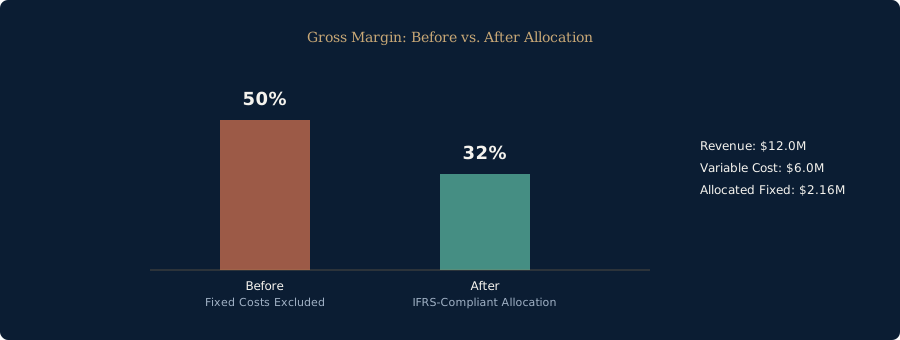
This series consumed 40 percent of total annual production capacity across crew availability, studio days, and equipment usage, so it should carry 40 percent of fixed costs: 40% × $5,400,000 = $2,160,000.
| Before Allocation | After Allocation (IFRS) | |
|---|---|---|
| Revenue | $12,000,000 | $12,000,000 |
| Cost of Goods Sold | $6,000,000 | $8,160,000 |
| Gross Profit | $6,000,000 | $3,840,000 |
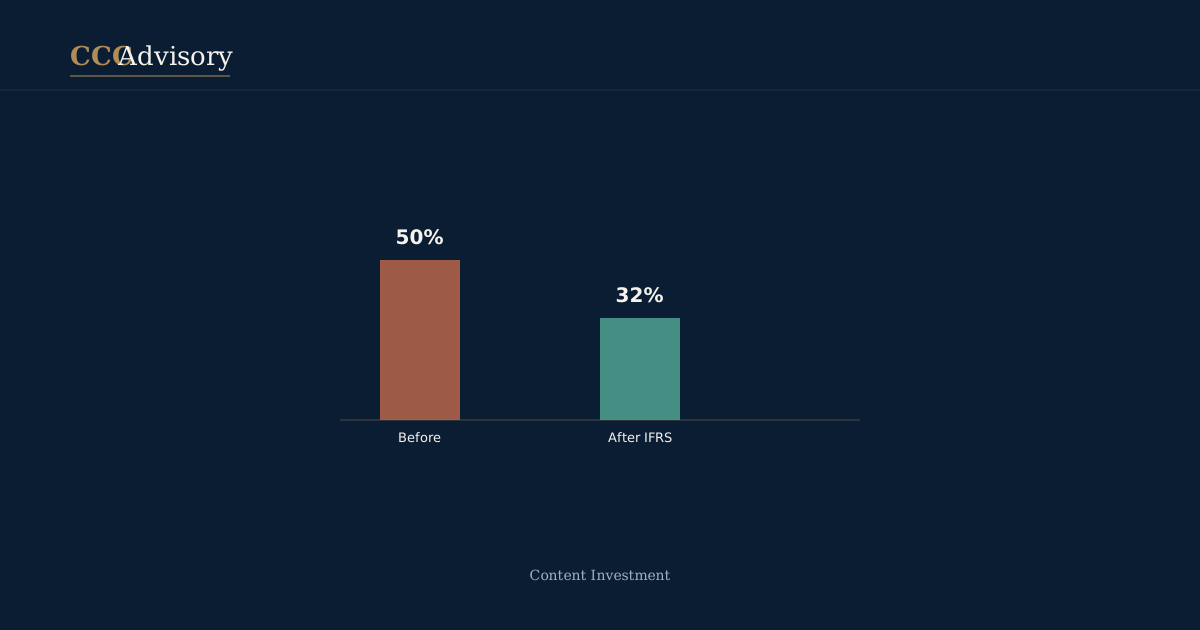
| Gross Margin | 50% | 32% |
Key Insight
Gross margin appears strong only because fixed production costs are incorrectly sitting in overhead instead of within the cost of the content. IFRS standards require that all direct and allocable production costs, variable or fixed, be attributed to programming inventory.
When proper cost allocation is applied: content is properly priced, since executives can no longer underprice rights because the true cost is visible; production efficiency becomes measurable, as underutilized staff, studio capacity, or equipment become transparent; business units become accountable for cost drivers, as finance can track cost per episode, cost per minute, and cost per asset lifecycle; and management avoids false profitability, as executives stop greenlighting projects that appear profitable but actually lose money.
The Strategic Advantages for Media Companies
- Accurate gross margin: a realistic view of financial performance across genres, formats, and platforms.
- Transparent pricing models: better pricing for licensing, VOD windows, digital rights, co-production agreements, international distribution, and amortization.
- Stronger internal governance: production teams become accountable for budget variances, utilization of crew, and efficiency of workflows.
- Enhanced decision-making: clear data to evaluate whether to build or rent studios, where to automate or digitize, when to outsource versus keep in-house, and which genres justify investment.
- Investor and board confidence: financial clarity builds trust and strengthens the company's credibility.
The Future of Media Finance: Treating Content as a Manufactured Product
As MENA's media sector accelerates, powered by government investment, new studios, digital platforms, and mega-projects, financial precision is no longer optional. The companies that will lead the next decade of content innovation share a common characteristic: they treat content like a manufactured product and apply rigorous, IFRS-aligned cost allocation models. This provides competitive pricing, sustainable gross margins, realistic profitability analysis, stronger partnerships, and greater resilience to market shifts.
In a world where the demand for content continues to surge, financial discipline becomes a creative enabler, not a constraint. Proper cost allocation is the silent engine that keeps the media industry transparent, competitive, and investable.
Leave a Comment